RQ 1. Address the utility of Guidelines for Salivary Gland Cancers (SGC)
National Survey of Salivary Gland Cancer Management (2026) – Please click on this link to access the survey
This survey is for all Clinical and Medical Oncologists managing salivary gland malignancies with current practice in the UK. Surgeons (ENT & OMFS) managing SGCs with current practice in the UK for questions on indications for adjuvant treatment and follow up. Please share widely.
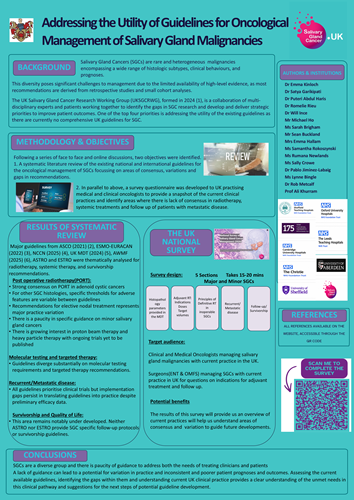
View our recent poster presented at BAHNO 2026 here
This workstream is to address the utility of guidelines for Salivary Gland Cancers (SGC)
There are no 'complete' guidelines fit for SGC currently, in the UK. There are existing generic guidelines that may cover an aspect of SGCs or guidelines may miss a specific SGC component. Existing international guidelines differ in some aspects e.g. ESMO-EURACAN and ASCO. From the patient perspective they can feel they are 'going in for a fight' each time when planning treatment or follow ups as there are disparate views. Disparate views in treatment planning and follow ups can extend to MDTs.
The RQ1 work to address this question is described below and the link to our medical and clinical oncologist survey is here:
National Survey of Salivary Gland Cancer Management (2026) (and below).
Please complete, share and help us to understand how best to address this important question.
Aim
Salivary Gland Cancers (SGCs) are rare and heterogeneous malignancies encompassing a wide range of histologic subtypes, clinical behaviours, and prognoses. This diversity poses significant challenges to management due to the limited availability of high-level evidence, as most recommendations are derived from retrospective studies and small cohort analyses.
The UK Salivary Gland Cancer Research Working Group (UKSGCRWG), formed in 2024 (1), is a collaboration of multi-disciplinary experts and patients working together to identify the gaps in SGC research and develop and deliver strategic priorities to improve patient outcomes. One of the top four priorities is addressing the utility of the existing guidelines as there are currently no comprehensive UK guidelines for SGC.
Method
The group conducted a series of face to face and online discussions to collate and review the existing SGC management guidelines. To clearly identify and address the specific gaps in research and clinical care, two objectives were set:
1. A systematic literature review of the existing national and international guidelines for the oncological management of SGCs focussing on areas of consensus, variations and gaps in recommendations.
2. In parallel to above, a survey questionnaire to be developed for delivery to UK practising medical and clinical oncologists to provide a snap shot of the current clinical practices and identify areas where there is lack of consensus in radiotherapy, systemic treatments and follow up of patients with metastatic disease.
Results
1. A systematic literature review of the current major guidelines was conducted. Thematic analysis of ASCO (2021) (2), ESMO-EURACAN (2022) (3), NCCN (2025) (4), UK MDT (2024) (5), AWMF (2025) (6), ASTRO and ESTRO revealed a substantial variation across the guidelines particularly regarding adjuvant treatments, particle therapy, elective nodal treatment and molecular testing. Gaps in guidance were identified in specific management of minor salivary gland cancers, follow-up protocols and survivorship.
2. The current radiotherapy contouring guidelines for SGCs (2,3,4,5,7), guidance for target delineation in perineural invasion and peri-neural tumour spread (8) were reviewed. The limited available guidance for follow-up protocols and survivorship were reviewed. The UK Survey questionnaire was subsequently designed and launched in May 2026. The responses are expected to provide greater insight into real world practices and identify potential areas where clinical judgements and recommendations are variable.
LINK TO THE SURVEY - click here: National Survey of Salivary Gland Cancer Management (2026)
Conclusion
SGCs are a diverse group and there is paucity of guidance to address both the needs of treating clinicians and patients. A lack of guidance can lead to a potential for variation in practice and inconsistent and poorer patient prognoses and outcomes. Assessing the current available guidelines, identifying the gaps within them and understanding current UK clinical practice provides a clear understanding of the unmet needs in this clinical pathway and suggestions for the next steps of potential guideline development.
References
- 1. https://www.salivaryglandcancer.uk/uk-salivary-gland-cancer-research-working-group-uksgcrwg/
- 2. Geiger JL et al. Management of salivary gland malignancy: ASCO guideline. J Clin Oncol. 2021;39(17):1909-1941.
- 3. van Herpen CML et al. Salivary gland cancer: ESMO-EURACAN Clinical Practice Guideline for diagnosis, treatment and follow-up. ESMO Open. 2022;7(6):100602.
- 4. NCCN Clinical Practice Guidelines in Oncology: Head and Neck Cancers. Version 2.2025. Plymouth Meeting (PA): National Comprehensive Cancer Network; 2024.
- 5. Homer JJ et al. Head and Neck Cancer: United Kingdom National Multidisciplinary Guidelines, Sixth Edition. J Laryngol Otol. 2024;138(S1):S1-S224.
- 6. Guntinas-Lichius O et al. AWMF-Register-Nr. 007-102OL. August 2025. Available at: www.awmf.org
- 7. Grégoire V et al. Delineation of the primary tumour clinical target volumes for head and neck radiation therapy: an international guideline (ESTRO-ACROP). Radiother Oncol. 2018;126(1):3-24.
- 8. Bakst R et al. Perineural invasion and perineural tumour spread in head and neck cancer. Int J Radiat Oncol Biol Phys. 2019;103(5):1109-1124
RQ1 Working Group Members:
Workstream Lead:
Dr Emma Kinloch
Workstream Members:
Dr Satya Garikipati
Professor Ali Khurram
Dr Puteri Abdul Haris
Dr Michael Ho
Ms Romelie Rieu
Dr Will Ince
Ms Sarah Brigham
Mr Sean Buckland
Ms Rumana Newlands
For expressions of interest, or any other questions about this workstream please contact [email protected]